What is a multi-agent system? Examples and what it is for
By Codara · Published: · Updated:
A multi-agent system (also written multiagent system or MAS) is a set of AI agents that collaborate, each with a role, to solve tasks that a single agent would not handle well. An orchestrator distributes the work, merges the results and keeps a person at the decision points that matter.
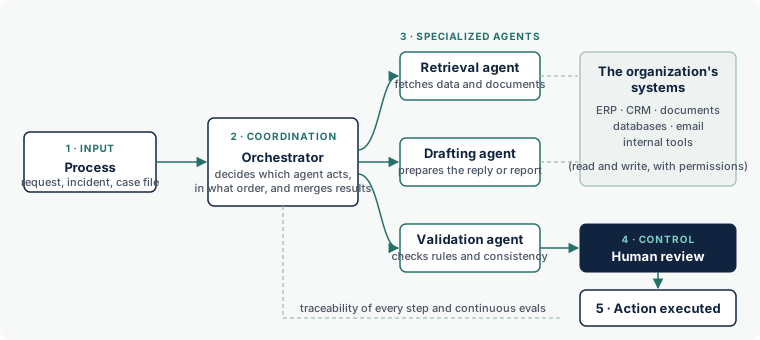
What a multi-agent system is for
A real business process is rarely a single task. It usually chains very different steps: retrieving information from several systems, analyzing it, drafting something, checking it against rules and, at the end, executing an action. A single agent trying to do all of that accumulates contradictory instructions, makes more mistakes and cannot be evaluated piece by piece.
A multi-agent system exists precisely for that: executing complete, multi-stage processes with the quality of a specialist at each stage. It is the right fit when the process:
- touches several systems (ERP, CRM, document management, email) that must be read from and written to with permissions;
- combines tasks of a different nature (retrieving is not drafting, and drafting is not validating);
- requires control: someone must be able to review what each piece decided and why.
How it works: roles, orchestrator and human control
The components are always the same, even though the design changes with each process:
- Specialized agents. Each one has a bounded goal, its own tools and its own quality criteria. A retrieval agent fetches data and documents; a drafting agent prepares the reply or report; a validation agent checks rules, consistency and format.
- An AI orchestrator. It decides which agent acts, in what order and how their outputs are combined. It can follow a fixed flow (retrieve, then draft, then validate), fan work out in parallel and aggregate it, or have one agent review another's work before accepting it. That coordination is agent orchestration.
- Connection to the organization's systems. Agents are worthless if they cannot read and write where the work lives. The connection is made with explicit permissions and is logged.
- Human review at the points that matter. Actions with consequences —sending, approving, modifying a record— go through a person before they are executed. The rest of the process runs on its own.
- Traceability and evals. Every step is logged and every agent is measured separately, so when something fails you know which piece and why.
Examples of multi-agent systems in the enterprise
Some patterns that recur in mid-to-large organizations:
- Incident management in operations. One agent classifies the incident and its urgency; another retrieves similar cases and the history of the asset or customer; another proposes the action and prepares the communication. A person approves before anything is executed on the maintenance system or the CRM.
- Case-file or contract review. One agent extracts the key data from each document; another checks it against internal rules and the applicable regulation; another drafts the review report with the exceptions flagged for the team to decide.
- Answering tenders and RFPs. One agent breaks the tender down into requirements; another searches internal documentation for answers and references already used; another drafts the response section by section. The sales team reviews and completes what only they know.
- Reconciliation across systems that do not talk to each other. One agent reads orders, invoices and delivery notes in different systems; another detects discrepancies; another proposes the entry or the correction. Differences above a threshold are validated by a person.
In all of them the value is not in one brilliant agent, but in the whole process being executed end to end, under control.
Multi-agent system vs. single agent
| Single agent | Multi-agent system | |
|---|---|---|
| Scope | One bounded task | A multi-stage process |
| Quality | Good if the task is simple; drops when instructions are mixed | Each agent specializes and is evaluated separately |
| Connected systems | One or none | Several, with per-agent permissions |
| Human control | Hard to place mid-flow | Explicit review points between stages |
| Cost and complexity | Low | Higher: needs orchestration, traceability and maintenance |
If the task is a single, well-defined one, the single agent wins. A multi-agent system pays off when the process is long, touches several systems or errors are costly.
Risks and how they are controlled
Several agents talking to each other can loop, multiply the cost per call or propagate an error from one stage to the next. That is controlled with step and budget limits per run, with an orchestrator that decides instead of letting agents negotiate freely, with traceability of every step and with continuous per-agent evaluations. It is what separates a multi-agent system in production from a demo.
How we approach it at Codara
We design each Agentic OS on Codara's own platform as an orchestrated multi-agent system connected to your systems, so it executes processes end to end in production, always under human control. An Agentic OS is, in practice, how a multi-agent system becomes a stable layer of the operation instead of an experiment.
FAQ
What is a multi-agent system for?
For executing processes that chain different tasks —retrieve, analyze, draft, validate, act— with more quality and control than a single agent. Each agent specializes in one part, and the orchestrator coordinates the whole and connects it to the organization's systems.
What are examples of multi-agent systems in the enterprise?
Incident management (one agent classifies, another retrieves the history, another proposes the action and a person approves), case-file or contract review, answering tenders from internal documentation, or reconciling data across systems that do not talk to each other.
Why divide the work across several agents?
Because an agent specialized in one specific part of the process performs better and is easier to evaluate and maintain than a single one trying to do everything.
How are they coordinated?
Through an orchestrator that decides which agent acts, in what order and how their results are combined, keeping a person at the decision points that matter.
When is a multi-agent system unnecessary?
When the task is a single, well-bounded one —summarizing a document, classifying an email— a single agent is simpler, cheaper and easier to evaluate. A multi-agent system pays off when the process has several stages, touches several systems or requires validation.